info@sriyaent.com
 +91 9825375241
Dodging Rules on Foreign Loans and Export Advances: A Costly Misstep for Companies. In today’s…
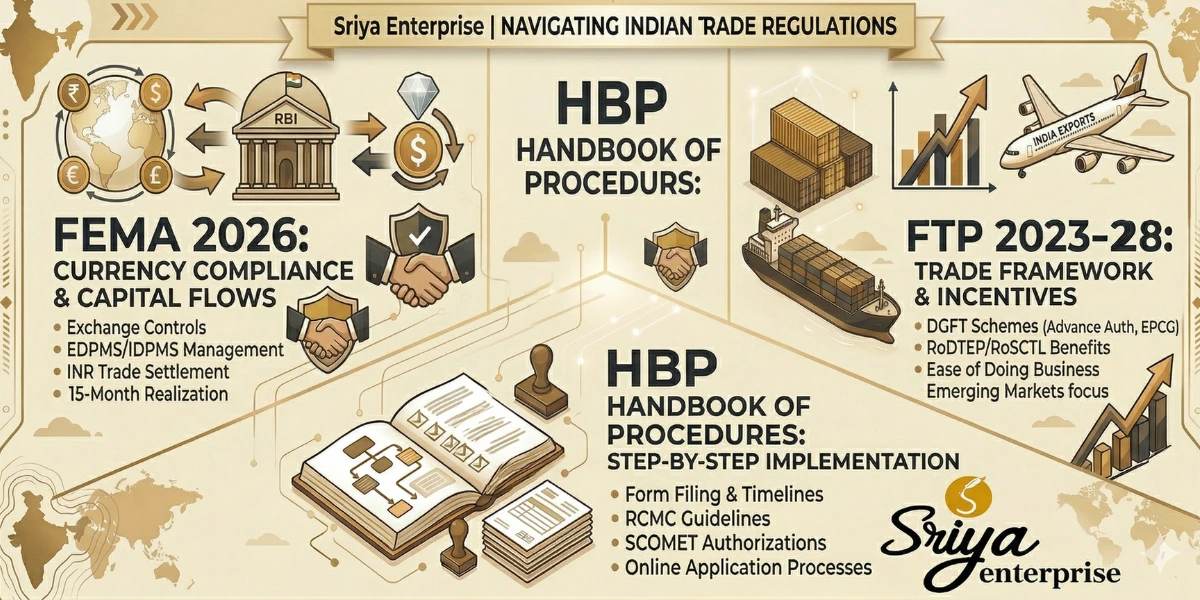
The world of international trade is often compared to a high-stakes game of chess. To win, you don’t just need a good product; you need to master the board’s rules. For Indian businesses, these rules are governed by a trio of pillars: FEMA, the FTP, and the Handbook of Procedures (HBP).
At Sriya Enterprise, a boutique FEMA advisory firm we specialize in helping MSMEs and startups navigate these complexities. Here is why every exporter and importer must treat these documents as their “Trade Bible” and what else you need in your regulatory toolkit.
The Power Trio: FEMA, FTP, and HBP
FEMA: The Guardian of Foreign Exchange
The Foreign Exchange Management Act (FEMA), specifically the newly introduced FEMA Regulations 2026 (effective Oct 1, 2026), regulates the flow of money.
- Why it matters: It dictates how and when you get paid. For instance, goods export proceeds must generally be realized within 15 months (18 months if settled in INR).
- The Risk: Non-compliance leads to your IEC (Import Export Code) being flagged in the EDPMS/IDPMS systems, effectively stalling your future trade.
FTP 2023-2028: The Roadmap to Growth
The Foreign Trade Policy (FTP) is the government’s vision for exports. It’s no longer just about incentives; it’s about Ease of Doing Business.
The policy is now “dynamic,” meaning it updates in real-time to match global market shifts rather than waiting for a 5-year overhaul.
Handbook of Procedures (HBP): The “How-To” Guide
If the FTP tells you what the rules are, the HBP tells you how to follow them.
It contains the specific forms, filing timelines, and step-by-step processes for every scheme mentioned in the FTP. Without the HBP, your application for an export benefit is likely to be rejected on technical grounds.
The Complete Checklist for International Trade
Beyond the core trio, a successful shipment requires alignment with several other legal and operational frameworks:
Customs Act & Tariff Rules
This is where your goods meet the border. You must understand:
- HS Codes: Correct classification to avoid heavy penalties or “mis-declaration” charges.
- Duty Drawback: Ensuring you get a refund on the duties paid for inputs used in exports.
Free Trade Agreements (FTAs) – India has signed significant deals, If your product meets the Rules of Origin, your buyer pays zero or reduced import duty, making your product more competitive than a supplier from a non-FTA country.
Maritime & Transport Law
International trade is physically governed by the Incoterms® 2020.
- Do you know when the risk shifts from you to the buyer? (e.g., FOB vs. CIF).
- This is your title to the goods. Understanding maritime law ensures you aren’t held liable for “General Average” or shipping delays beyond your control.
SCOMET Guidelines
If you deal with high-tech, chemicals, or dual-use goods (civilian and military), you must refer to SCOMET (Special Chemicals, Organisms, Materials, Equipment, and Technologies) to ensure you aren’t inadvertently violating national security protocols.
Ready to streamline your export-import compliance? Book a consultation with Sriya Enterprise today.
Why Professional Advisory is No Longer Optional?
The regulatory landscape in 2026 is becoming increasingly automated. With the RBI and Customs syncing data in real-time through ICEGATE and EDPMS, “small mistakes” are caught instantly by AI-driven systems.
How Sriya Enterprise Empowers You:
- We help resolve long-pending entries in EDPMS/IDPMS
- We ensure your documentation (Letter of Credit, Bill of Entry, etc.) is airtight before the bank or customs raises a query.
- We offer captive workshops to train your team on the latest 2026 FEMA updates.
Expert Tip: Don’t wait for a “Caution List” notice from your bank. Regular reconciliation of your export realization is the only way to ensure your business stays “Open for Global Trade.”
Frequently Asked Questions
FEMA regulates foreign exchange transactions, FTP defines export-import policy and incentives, and HBP provides procedures and documentation for export compliance.
FEMA ensures exporters receive export payments within prescribed timelines and comply with RBI regulations to avoid penalties or caution listing.
The Foreign Trade Policy is the government’s policy framework that promotes exports through incentives, schemes, and ease of doing business initiatives.
The Handbook of Procedures provides step-by-step instructions, forms, timelines, and documentation required to implement schemes under the Foreign Trade Policy.
Non-compliance may lead to EDPMS or IDPMS issues, export payment delays, penalties, and restrictions on future export-import transactions.
Related Posts