info@sriyaent.com
 +91 9825375241
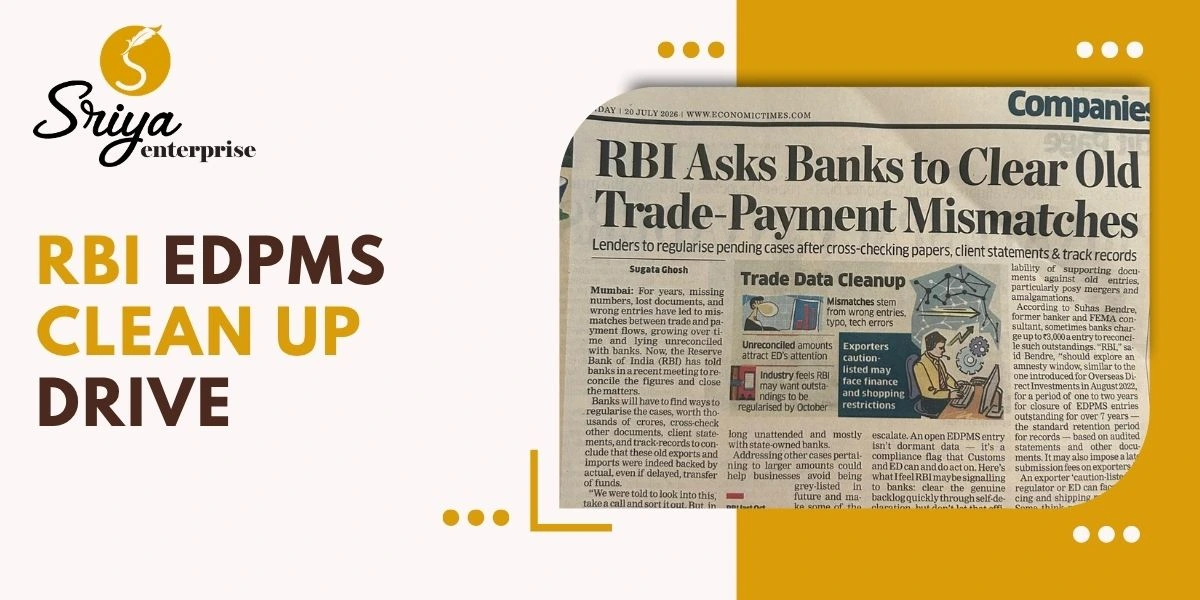
RBI Trade Data Cleanup: Why Sriya Enterprise is Urging Businesses to Reconcile EDPMS /IDPMS Entries…

The rapid ascent of the Indian economy toward the third-largest global position has turned the world’s eyes toward our trade corridors. However, as India solidifies its status as a global trade hub, the regulatory oversight surrounding that growth has become more sophisticated and stringent.
For businesses navigating this landscape, the “invisible” digital eyes of the Export Data Processing Monitoring System (EDPMS) and the Import Data Processing Monitoring System (IDPMS) are no longer just administrative portals—they are active compliance benchmarks.
Understanding EDPMS & IDPMS
These RBI platforms act as a bridge between the Customs database and your banking records. They automatically track every Shipping Bill (Exports) and Bill of Entry (Imports).
The mechanism is simple but unforgiving:
- Customs logs the transaction.
- EDPMS/IDPMS flags the entry as “Open.”
- The AD Bank must “Close” the entry once realization or payment is verified.
- Failure to close within the statutory timelines (9 months for exports / 6 months for imports) marks the transaction as a potential violation of the Foreign Exchange Management Act (FEMA).
The Cost of Oversight: Enforcement and Penalties
Under Section 13 of FEMA, the consequences of un-reconciled entries are severe. The Enforcement Directorate (ED) has intensified its focus on data-driven investigations, using “Open” entries in these systems as primary evidence for issuing notices.
- Penalties can reach up to three times the amount involved in the breach.
- Investigations can limit your ability to seek fresh RBI approvals, effectively freezing specific cross-border workflows.
Why Entries Stay “Open”: Beyond Actual Defaults
At Sriya Enterprise, our advisory experience shows that many “defaults” are actually procedural oversights rather than a failure to move funds. Common friction points include:
- Neglecting to provide specific receipt or payment advice to the Authorized Dealer (AD) bank.
- Differences between the value declared on Customs documents versus the actual realized amount due to commercial adjustments.
- Untraceable entries from years past that continue to haunt the current compliance dashboard.
- A lack of awareness regarding specific RBI exceptions or the process for transferring entries to an alternative bank for closure.
The Sriya Edge: Proactive Reconciliation
The window for rectification narrows the moment an investigation is initiated. Sriya Enterprise specializes in bridging the gap between modern trade workflows and these traditional regulatory requirements.
We don’t just view this as data entry; we view it as Nuanced Compliance. By auditing your outstanding entries, identifying commercial reasons for discrepancies, and facilitating the right approvals with AD banks, we ensure your firm remains an “AI-era” trader—fast, efficient, and above all, compliant.
Action Step for Exporters & Importers
Do not wait for a notice to audit your EDPMS/IDPMS dashboards. Periodic reconciliation is the only defense against exemplary penalties.
For a diagnostic review of your outstanding trade entries, connect with us at Sriya Enterprise.
Frequently Asked Questions
EDPMS (Export Data Processing and Monitoring System) and IDPMS (Import Data Processing and Monitoring System) are RBI monitoring systems that track export and import transactions through Shipping Bills and Bills of Entry.
These systems help RBI and Authorized Dealer (AD) banks monitor whether export proceeds are realized and import payments are completed within prescribed FEMA timelines.
If an entry remains open beyond the prescribed timeline, it may be treated as a FEMA compliance issue and can trigger bank escalations, RBI scrutiny, or Enforcement Directorate notices.
Generally, export entries must be closed within the RBI-prescribed realization period and import entries within the applicable payment timeline, unless valid extensions or exceptions apply.
Entries often remain open due to procedural issues such as missing bank advice, unmatched documentation, value mismatches, short realization, delayed reporting, or unresolved legacy transactions.
Conclusion
In today’s digitally monitored trade environment, EDPMS and IDPMS are no longer passive reporting systems—they are active compliance checkpoints under FEMA. Even when funds have moved correctly, unresolved entries, documentation gaps, or procedural mismatches can expose businesses to unnecessary scrutiny, penalties, and operational delays.
For exporters and importers, compliance is no longer just about completing transactions—it is about ensuring every transaction is accurately reconciled, reported, and closed. Proactive monitoring of EDPMS and IDPMS is the only practical way to reduce regulatory exposure and maintain uninterrupted trade operations.
As regulatory systems become more automated and enforcement more data-driven, businesses must treat reconciliation as a core part of trade governance. A timely review today can prevent costly consequences tomorrow.
Related Posts